My vessel currently has everything working well, but it seems like it is time to redo it- and get it all organized (the under helm wiring looks like a nightmare).
Any brands to go towards (or away from) when it comes to:
marine tinned wire
Bilge w float switch
Fuse and bus boards
Battery on/ off switch
Also would like some quality rocker switches for the helm and some red interior lights.
I’m doing a full de-rig and re-rig on a flats boat right now. I got it all de-rigged last week and all aluminum off and at the powdercoat shop. Full re-rig coming soon. I’m buying as much as possible from New Wire including a customized switch panel with custom labeled switches for my customer. They have it all!
I have always had good service from Rule bilge pumps. Their float switches are total junk! I had really good luck for fifteen years with Water Witch float switches. No moving parts. The Ultimas are highly regarded. When it comes to bilge pump switches, I use the No Rule rule. TJ
The current wiring is now 10 yrs plus old and has a number of dead wires just entangled in the snarl.
I am not a mechanic or electrician, but for piece of mind, I would like to redo it so 1. I don’t wind up with issues 2. I know it is done right (assuming I can do a good job) 3. It will be clearly labeled so I can repair should I have issues in the future.
I also want to add a battery switch (yup, not currently in the system) and the float switch.
Cost depends on if I can get the good stuff needed- I would rather pay once and do it right.
It is pretty simple overall.
Bilge, ignition, running lights, interior lights, and probably a switch for electronics (feel a switch may be a good idea… but maybe not).
Ok, just the basics, battery switch for starting/house power. Assuming 1 battery to share start/house. You need a main breaker after the switch (According to ABYC standards, the main breaker should be within 7 inches of the battery terminal on the ungrounded conductor.) I’d recommend getting a negative buss bar for all your circuits to ground to. For positive there are a few options, you can go with a fuse block, breaker block or built the breakers into the switch panel. You can her shrink wrap labels for each circuit. You’ll need plenty for wire, and terminals.
A switch for electronics is not needed if you use a main battery switch that disconnects the battery from the loads.
There are a lot of details I’m leaving out, but a DIY rewire, assuming pulling every wire and running new, pending how many circuits, can quickly cost you up to a grand or more once you buy all the materials. There are a lot of variables that can cause the price to go up or down.
Some have their own approach, but I’ll share what I prefer.
I run items independently as much as possible using a unique color wire for the hot. My GPS is a yellow hot, my NMEA uses a blue hot.
I do not like jumping wires between items, for example - jumping from one gauge to another. I’d rather have those go to a bus bar. If one item fails, it can cause a failure down the line and make trouble shooting difficult.
Common / neutral are black and run to a bus bar.
Cable label makers are great for neutrals and especially great if using the same color wires for hots.
High power items should be on their own fuse. I’ve seen trim tabs and jack plates share the same wiring to the bus. I like these separated - if something is throwing a fuse, which one is it? That isn’t fun to figure out while on the water.
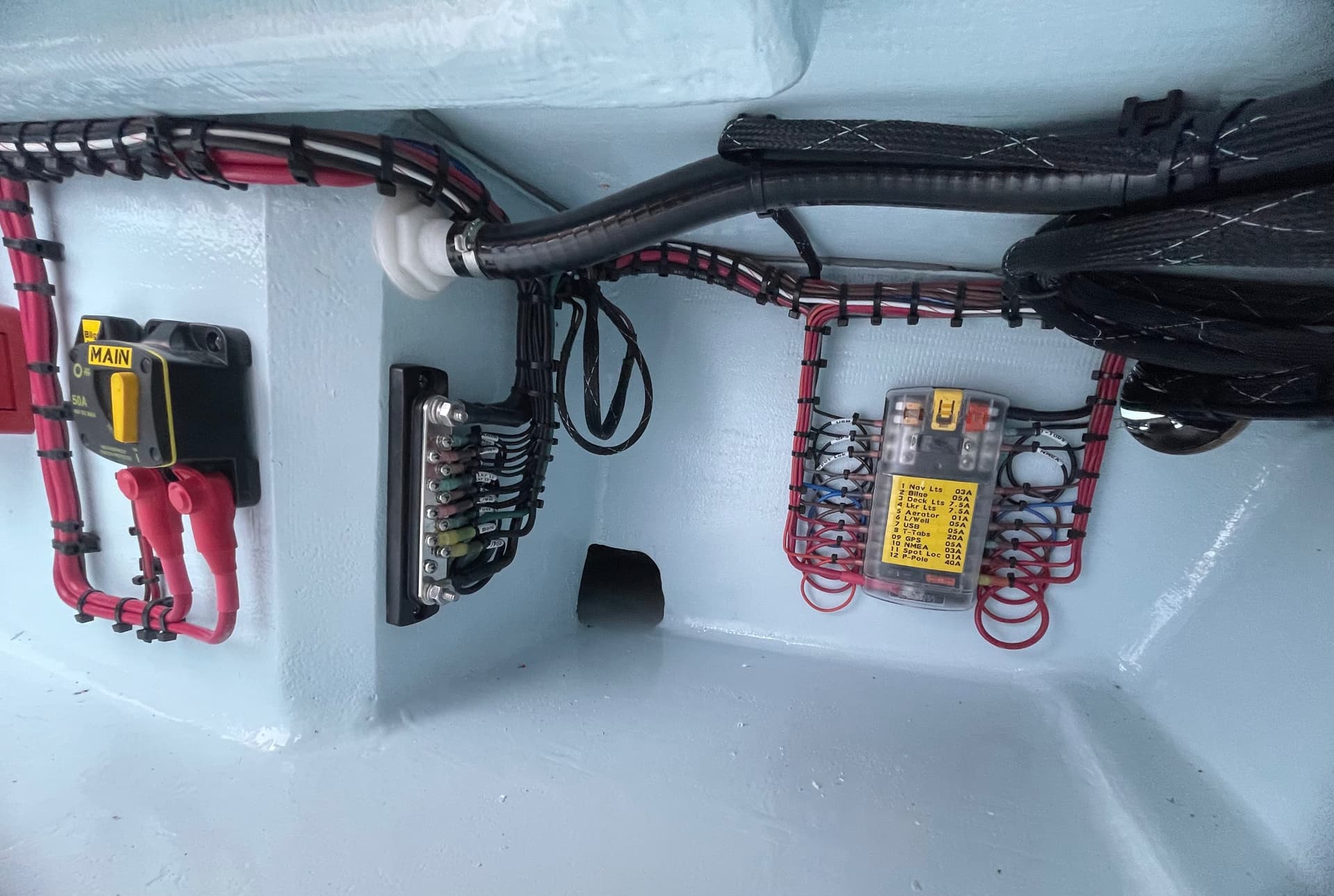
Check out this rigging job from the Skiff Shop inside a Deadrise Palometa.
The loops are also a great addition. Wires oxidize over time, so having more room to cut back and have some buffer is nice to have.
Use dialectical grease on the connections and the fuses. Periodically check the voltage at the fuse and each connection. It is surprising how much a corroded fuse or connection will degrade voltage, causing issues.
Wire size for long runs is important. Hot and neutral must be the same size, or the smallest wire becomes the weakest link and dictates the overall voltage.