It won’t hurt to have them. I am meticulous with washing down my stuff and still have corrosion.
1 Like
I purchased those small anodes at west Marine, although i probably could have used the ones from my engine annual replacement. I did have to drill a wider hole though.
2 Likes
Coconut is spot on. The taller pole type guides help you see the trailer when it’s empty. If I had this style of guide, I’d still contemplate adding poles outside of those guides.
2 Likes
Maybe this is me just being a cheap garage mechanic but if those were not warrantied I would have:
Cleaned up very well
Smother in JB weld and fair out to original shape
Reapply with the methods above
All this because it’s not a real load bearing piece and the rest was still in decent shape.
I ordered some anodes for my Ramlin trailer after reading this thread. I got mine off Amazon. Lots of choices.
The anodes Loogie used are very similar to the ones for a Honda or Yamaha F70 below each side of the motor mounts. You shouldn’t be paying more than $3-4 for them. The Zinc Guy in Florida has very good quality anodes that are very pure and fairly cheap. There is no such thing as too big of an anode but definitely too small. The bigger the anode by weight the slower it will sacrifice itself and the more metal it will protect. The ones Chittum uses on their transoms now are Camp or Martyr A24 size and shape. I picked up fifteen for $8.50 each on sale from Boats.net last month. They are a substantial size. You can easily drill zinc, it’s soft. Just be careful when your bit grabs, your drill will nearly break your wrist or snap your drill bit if you push down too hard. I clamp them down in my vise to drill them.
5 Likes
I ordered a couple outboard anodes off Amazon (paid too much). One arrived in today’s mail in a padded envelope probably 20X its size. The second was delivered by Prime this afternoon in the same size envelope. Guess they came from two different warehouses. These are pre-drilled with a single recessed mounting hole. I’m going to go ahead and mount them on the trailer, but I’ll go look at West Marine or some other outlet first when these need replacing to get larger sizes (and hopefully cheaper).
I did find some Volvo zincs on eBay for $4, but they wanted $95 to ship from Sweden. LOL
Edit: After looking at the invoice again, mine were $9 each, plus tax and shipping. So not too bad.
I was with hipshot Friday, and just like Loogie’s one of his trailer’s side bunks fell off. The trailer’s not two years old. Ramlin needs to figure out a solution, and do something different. Maybe if the carpet didn’t cover the whole back side of the bunk board, it wouldn’t hold salt water and could dry? I have an aluminum boat and early on, I was warned not to have carpeted bunks. A neighbor’s custom aluminum boat had four “slots” eaten thru the bottom, due to salt in the carpeted bunks! Food for thought. I would buy stainless T-nuts and bolts and forget the lag bolts. TexasJim
Yes I was thinking of using hard plastic material like they use on docks, cover it with carpet, and mount it with stainless through bolts recessed on boat side.. I believe the new wooden ones I installed will be more resistant to the corrosion the way i insulated them. I will keep an eye closely and not allow the chemical reaction to develop as much as i did last time.
2 Likes
Loogie: Whatever you do, don’t sandwich the carpet between the aluminum and the wood or plastic. The carpet holds the saltwater. I would put some plastic tape, or a thin plastic shim between the aluminum and the wood. It wouldn’t hurt to put some vertical grooves in the aluminum, to ensure draining and flushing with fresh water. Look at the plastic bunk covers they sell. They have slots and interruptions, to allow draining. If the saltwater ain’t there, it can’t cause a problem. Ramlin should know better than to build a water trap in their bunks. Good luck! TexasJim
2 Likes
Damn it Ramblin!
I did isolate the carpeted bunk from the aluminum as @Smackdaddy53 suggested, so it should last, however in the future I might try the other material solution.
1 Like
I posted above that Ramlin sells replacements for over $250. The aluminum plate is the part that deteriorates, but the entire arm bracket has to be purchased. That’s a lot of material being purchased for what is really a small part failing.
IMO, they didn’t design these bunks to get dunked. At least on my trailer, which is a dry launch. But each ramp is different and dry launching may not be possible. They can be kept above the water line most of the time, but the problem is they are so low, they are hard to see when backing, especially in the dark.
To buy me time on mine, I drilled two new holes on the inside of the plate between the arms and put in two new screws. I removed the old screws and filled with JB weld, then screwed them back in. I’ll pull the brackets in the off season, cut off the plate and weld in a new one. For the bunk, I am going with a composite board and will glue down the carpet.
4 Likes
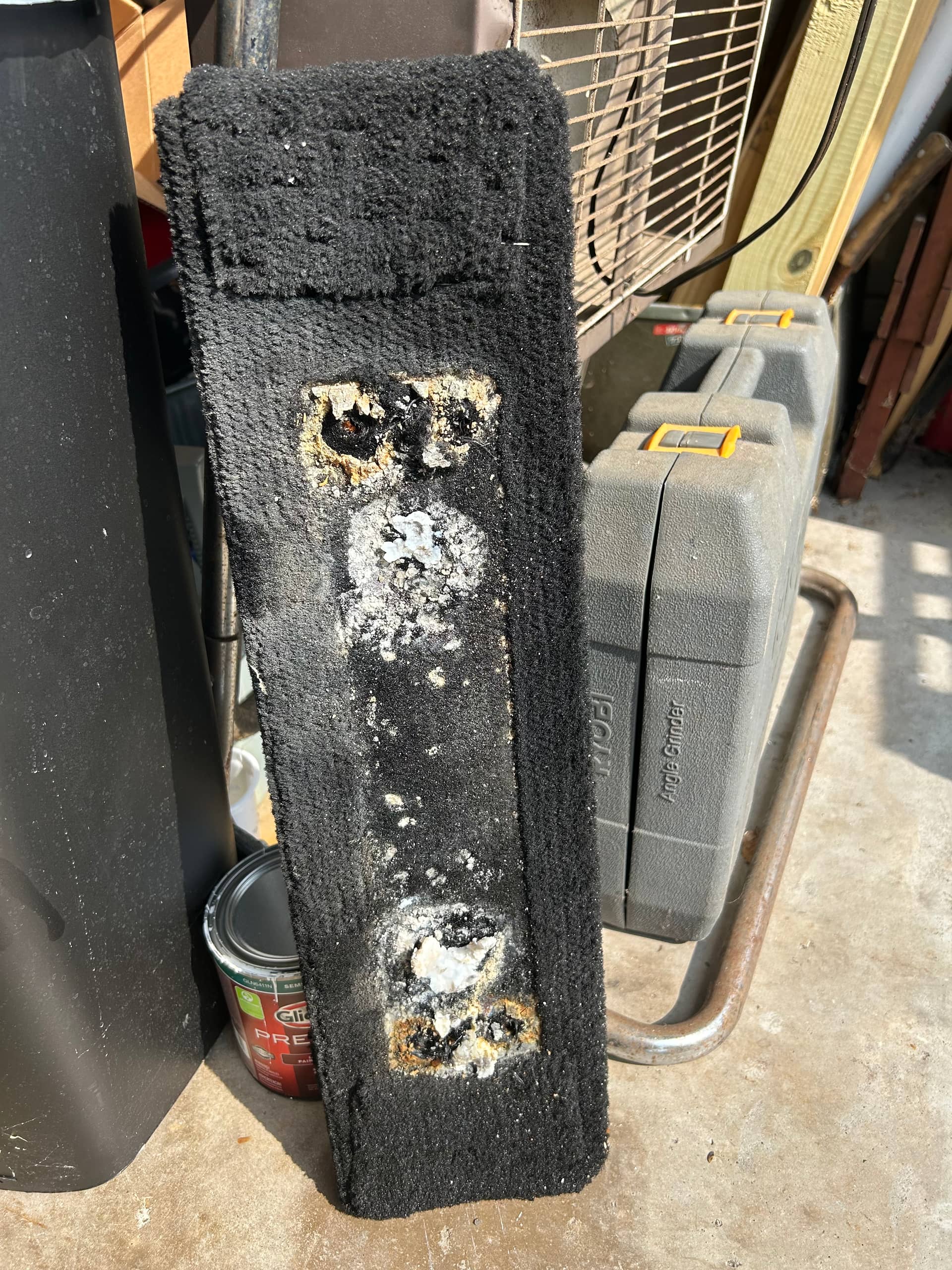
My guide bunks have never been under water, although I’m sure the carpet has absorbed some water off of the hull when loading the boat. The screws through the plate are frozen in place (they gouged the hull). The aluminum plate has some deterioration going on around the edges; I hadn’t noticed it under the carpet. The bunk itself is mush, and there are some big glops of soft white substance that looks like Crisco or white grease, about the consistency of pudding where it was up against the aluminum plate. I always liked AmeraTrail better than Ram-Lin; this just reinforces that. Since the warranty is one year and the trailer’s two years old, I won’t waste my time calling Ram-Lin; I already know what they’ll say

3 Likes
@hipshot - I would reach out to Ramlin anyways. The worst they will say is no. You may start first with Chittum, or go back to Chittum for leverage if Ramlin turns you down. Another reason is the surplus in cost that Ramlin adds to their “Chittum Trailers.”
That should not have deteriorated so quickly. My Ramlin is 10 years old and the bunks are in better shape with me dunking them. Even if it is out of warranty, maybe they will comp one part or give you them at cost.
2 Likes
Hipshot try going to Ramlin through Chittum, they have leverage. Harry at BT did that for me and got me a new set. That should not be happening, it’s exactly what happened to mine and they covered it, my trailer is a 2023 model.
Chittum does not use Ram-Lin any more, they’re on Ameratrails.
2 Likes
I passed this thread on to Kevin Morin, my aluminum boat build mentor (40 years of building aluminum boats for commercial fishing) and asked for his thoughts. His comments are below. He also provided links to articles for those who are interested in learning more about the types/mechanisms of corrosion, they follow his comments.
– Carl
#1 The copper treated lumber combined with plastic ‘carpet’ are the sole sources of the galvanic corrosion shown. There is no stray current present so ‘zincs’/anodes are not going to solve the problem. When immersed, soaked, or even damp; is the only time the SS, Copper, Aluminum ‘battery’ has an electrolyte to facilitate the corrosive cell… The wooden ‘bunk core’ is retaining the water and wrapping it in plastic makes sure it stays damp. The claim by the trailer builder that only salt water will act as an electrolyte isn’t accurate. Rinsing will not eliminate the problem - the salt water immersion starts the galvanic cell and it can be kept by susequent rain water.
#2 The cores of these bunk plates (cores) should be Starbright or just grocery store ‘cutting boards’ of HDPE or another all plastic material. The carpet wouldn’t have any real effect if the core wasn’t laden with copper ions; & wet!
#3 The idea that the anodes will delay, attenuate, eliminate this local galvanic cell is not real world. The local corrosion is not coming from a stray current on the trailer frame so; ‘zincs’ or anodes won’t protect the aluminum 2’ away. Sacrificial anodes only work to give up metal ions to the water (electrolyte) BEFORE the hull metal or current conducting metal appendages underwater… this trailer does not have that instance of corrosion. The only way anodes on this trailer will help is if the trailer frame is used for DC neg Return- and I can’t imagine the builder being THAT far out of touch?
#4 The bolts (retaining the side cushion/bunk pads) would be best if they were hot dipped Galvanized not SS. IF SS (?) then they need to be passivated w/ Naval Gel or passivating solution and even then they’d be much better installed in a PEX tube sleeve w nylon washers between SS washers and aluminum; then filled with silicone sealant or 5200.
#5 One poster mentions that a metal boat with carpet covered bunks showed ‘bunk rot’ or crevice cell corrosion supported by de-areated water standing against the hull. All aluminum hulls with bunks (regardless of orientation) should have bunk covers with solid plastic that has a ridged surface to keep from forming a thin film of standing water that can shift ph with reduced oxygen content of the water film. Rollers should never be used on aluminum hulls on trailers unless they are specifically located in very exact correlation to the interior framing and hull seams. Otherwise, the 2 tonne truck strap holding the trailer to the roller system will deflect the hull to max strain and then highway speed movements will impact the hull in a point load far exceeding anything possible on the water- this may and often does result in ‘star-cracking’ hull panels.
4 Likes
Great info @m32825
Starboard is what I had in mind, but the thickness only goes to 1” - I haven’t found anything thicker. It can be bonded - I’ve done it. Poly lumber on the other hand has a lot of options, including 2 x 4 precut sizes. Searching “poly lumber” or “HDPE lumber” will return lots of options.
Following let me know what you end up with, and I might switch my bunks…