I didn’t want to derail the other thread, but I had a question. To quote @KeithS :
I have an original GLX, not Crosscurrent, though I expect these are similar. Have cast it and the Asquith 7 a lot, and have enough other weights of NRX+ to know how this line of rods behaves.
Asquith and NRX+ are very different. Asquith is relatively soft and very fast. Light and low swing weight. Very responsive. A joy to cast at all but the longest distances.
NRX+ is stiff and moderately fast. Light, but heavier swing weight. What you get for this extra stiffness is the ability to throw very long. It’s the best tool I have found for long casts.
Maybe I’m not understanding the difference between stiffness and action. I found it confusing that a rod (Asquith) could be soft (assuming moderate stiffness) and very fast action and another (NRX+) could be stiff yet moderate/fast action.
I’m probably not understanding action very well because in my head it was kinda associated with stiffness, but obviously its not and I’m having a hard time understanding the difference. Anyone care to try and help me understand the difference? Thanks. Forgive my obtuseness
To me fast doesn’t necessarily mean stiff. I would describe it as “crisp”.
A better way to put it is fast, very fast, etc refers to recovery of the blank from bent to straight which is going to increase line speed. For instance an Asquith like a lot of the Hardy rods I like is going bend pretty deep in the blank and fish well with a true to weight line but recovers very quickly.
While there are rods like a Sage Method that is very fast but also very stiff.
You make a great point. Every manufacturer has its own terminology for rod performance, and every angler has their own interpretation of what that means. It’s all pretty subjective. I’m admittedly out of touch with the latest lingo and trends in the rod world, so I’m left with two options: brush up on all the new terminology, or just go cast some rods and see what feels right. Nine times out of ten, I choose to cast. You really can’t go wrong that way.
I can get what they mean. I think. I can picture a rod with a lot of bend that recovers quickly. What I’m having trouble imagining is a stiffer rod that recovers less quickly. I have made an association with stiff rods being fast, and I can see how a delicate rod can also be fast, but its the reverse I’m having trouble “grasping”…
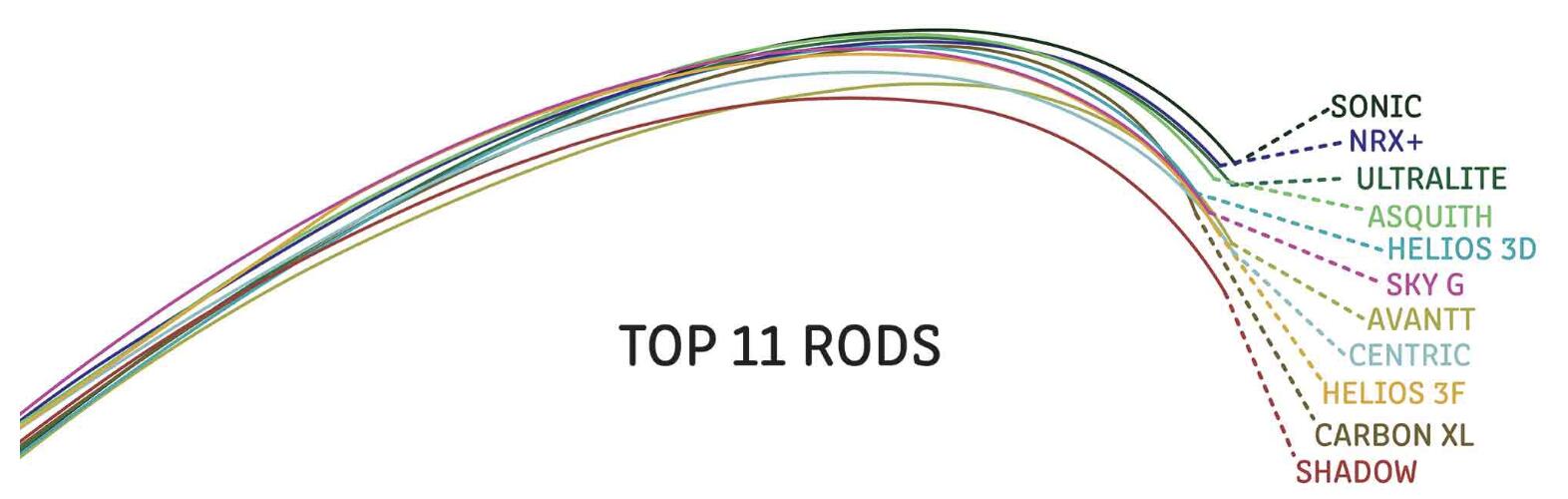
Action comprises stiffness versus softness, and fast versus slow. This Yellowstone deflection chart (for 6wt rods) shows the differences. Sonic is stiffest and Shadow is softest simply because the tip deflects more for a given weight. A fast rod is one that deflects little at the butt and a lot at the tip. Sky G is the stiffest for the lower half of the rod, but ends up having tip deflection in the middle of the pack. This makes it very fast. You may have to enlarge the chart to see it, but Asquith (a little less fast) is one of the stiffest throughout the lower half, but ends up deflecting more than NRX+. Deflection for the slower NRX+ begins just above the butt and occurs more evenly throughout the rest of the blank. These details make the rods feel very different.
What he says about the NRX+ is very true. Very heavy swing, feels very stiff, if you get it sweet it will go a long way. But for short, redfish shots, it’s awkward.
In short
Action is related to where the rod bends in relation to casting, where it bends
Stiffness is how much power you need to apply to get the blank to bend, how much power/force it takes to bend it
I’m quite certain you’ll get a more precise answer from someone on here.
I’m going to throw a wrench in the gears for a second.
I’m a TFO guy. Pretty much had them all at some point. My current salt rods are the Mangrove and Axiom II X.
The Mangrove has a significantly stiffer butt section than the Axiom IIx. But the Axiom is the faster/stiffer rod. Make it make sense!!
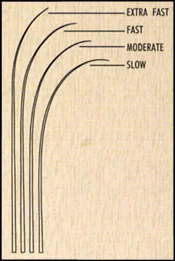
Mudhole has a similar chart. The problem with both is that they show fast rods being stiff and slow rods being soft. This makes it quite confusing (as rovster noted) trying to separate stiff versus soft and fast versus slow. They are two different things. Both are static characteristics, that is, you measure them when the rod is not moving (with a weight hanging from the tip).
In my explanation above, I encompassed stiffness and fastness in “action.” Mudhole calls fastness “action” and stiffness “power.” Either definition works. The two static characteristics are still the same.
There are also two dynamic characteristics, response (or recovery or natural frequency) and damping. The first describes how quickly the rod unbends after being deflected. This is often confused with the static characteristic of fast versus slow, but it is different. Response is measured while the rod is moving.
Damping describes how many cycles the rod wags backward and forward before it finally stops moving.
The biggest issue is, there is no standard. One MNF fast is another’s mod/fast and another’s xfast. I’m not really sure there is an end to this rabbit hole unfortunately. Especially with all the “proprietary” rod formulas on the market.
It is easy however to make the fast=stiff assumption, but that’s not always true, as speed comes from the tip, power from the butt. This also circles back to fly rods not being built to true weight specs. Which is why some rods need to be over lined. So that fast, stiff 8wt in reality is really a 9 or possibly even a 10wt in some cases. Which would then make a true 8wt seem soft in comparison. Somewhere a while back I stumbled on a video of Flip addressing this as well.
Vinny and Keith are correct….action is simply where the rod bends to an equivalent load and power is deflection for a given load. Recovery (you might call this crispness) is a totally different characteristic unrelated to action so a fast rod still may not feel as crisp as another rod.
If you take two 8 weights and apply say 200 grams to them, one may bend to the butt(slow)where the other only bends halfway down(fast). This shows the difference in action. But these blanks could still have the same power the way it is measured
I usually define action as where the rod actually bends down the blank. If you hold two different rods in your hand and push the tips against the floor with equal pressure you should notice that they don’t bend in the same spots. That’s action. The more it bends into the butt of the rod the slower the action.
Stiffness or power in the fly world would translate to the spinning world as medium, medium heavy, etc. so I usually equate that to actual line weight of the rod. The rods actuall ability to hold the weight of a fly line in the air. This gets subjective and confusing because hardly anyone follows the standard for fly lines anymore (see other threads).
you have to also consider the asquith has more technology (effort from the manufacturer?) in keeping the rod from vibrating in ways you don’t want it to. But in my observation the Asquith is a slower action rod than the nrx, meaning if you push them to the floor, or see @KeithS taper chart you’ll see that it bends more and lower into the rod than the nrx. This generally means the rod is going to have more “feel” but less ability to cast longer distances if all the other factors are the same.
one thing people need to take into account is I can make an asquith feel really fast by putting a true to grain weight fly line on it. Then make an nrx feel really slow by overlining it with something like a rio flats pro or SA grand slam. You can manipulate the feel, action, and performance of a rod quite a bit by changing the fly line on it.
Sounds like I would really like an Asquith and I tend to gravitate to rods with a little more feel and bend? All this makes sense it always had but that one post really threw me for a loop. Thanks for all the replies.
- Action is where the rod bends at. Tip flex, or mid-flex is an example.
- Stiffness is how much energy it takes to make it bend.
@VinnyL explained it concisely very well and @KeithS gave us a more detailed clinic, but added two more things that are really important - response and damping. These relate to “wobble” and “tip bounce.”
While moving a rod back and forth, how quickly a rod stops moving when the cast abruptly stops is important. Damping helps reduce the tip bounce, which affects accuracy. Conversely, how quickly a rod reacts is response.
Figured I’d give another opinion here, but I prefer thee NRX+ over the asquith in the 8wt and 9wt (and probably 10&11, just haven’t cast them). Most of my shots are short to mid distance, and I think the rod does great at those distances. It obviously has the ability to launch line out far as well. I fish 1/2 overweighted lines on it, so that probably helps. I also have friends who prefer the asquith. You need to cast both before you decide. The 8wt and 9wt asquith are great rods, but for my casting stroke they don’t have the feel the NRX+ does.
The one exception would be the 7wt asquith. I can’t imagine anyone not liking that rod.
Another complicating factor is rods in different weights but of the same maker/product line vary in their level of speed/stiffness ratios. A good article about why rod makers tend to make lighter weight rods faster and heavier weight rods softer here (see about 3/4 into the blog): Balance Taper Fly Line - The Angling Company
This leads to any fly fisherman having to do a lot of expensive rod+line experimentation…maybe this is a feature not a bug.